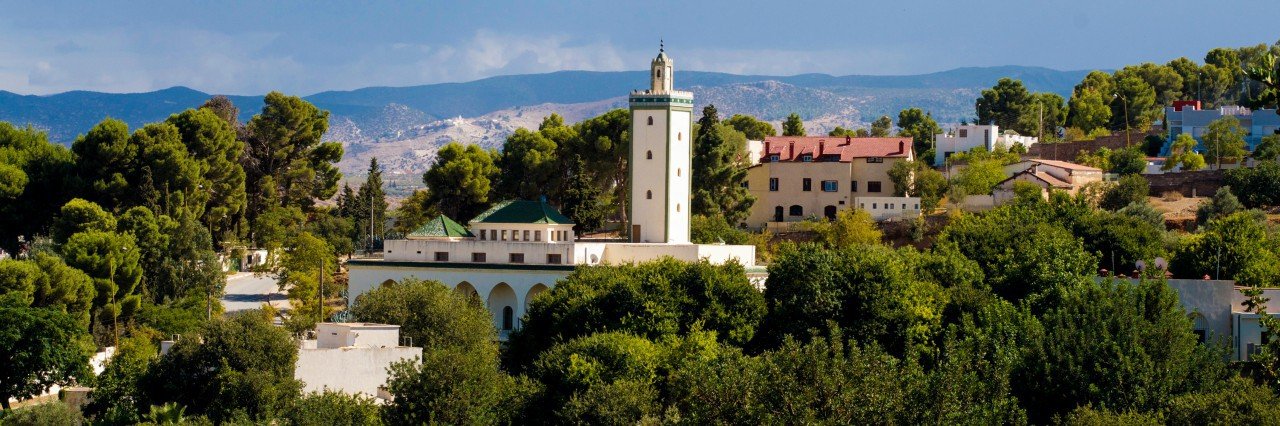
Sefrou is an idyllic Moroccan town located on the edge of the Middle Atlas Mountains in the Moroccan interior, about 30 km from Fes. Like many of its neighboring towns and villages, Sefrou today is a blend of tradition and modernity. The city still continues to produce traditional handmade artisanal items while also being a contemporary Moroccan city. Approximately 64,000 people consider Sefrou their home in this originally Berber city, making Sefrou a bustling and happening place without the overwhelming feeling that one may experience in Casablanca, Fes, and Marrakesh.
In 2013, Sefrou was recognized by UNESCO, the United Nations’ world heritage organization, for its cultural history and preservation. Sefrou was once a dynamic cultural crossroad where Jews, Muslims, Berbers, and Arabs peacefully coexisted for over several centuries. It is even believed by some to have Christian and Roman origins, as Sefrou is not too distant from the ancient Roman city of Volubilis. In its halcyon days, Sefrou was a prominent resting place and trading post on the Tariq Al Sultan, or the Sultan’s Road, an old route that merchants traversed between the Sahara and the Mediterranean Sea. The road in part contributed to Sefrou’s diverse character and tolerant environment that it continues to hold today, albeit with less prominence.
The theme of cultural diversity is most noticeable in Sefrou’s former Jewish community, once among the largest in Morocco. With a population of about 8,000, Sefrou’s Jewish community was not only one of Morocco’s largest but also among the most concentrated Jewish communities in all of North Africa. Jewish residents once referred to the town as ‘Little Jerusalem’. Even by 1956 when Morocco gained its independence from France, Sefrou still boasted a Jewish population of about 5,600. Most of these Jewish inhabitants lived in the Mellah, or Jewish quarter of the old city, but only several remain there since the mass exodus of Morocco’s Jews in the late 1960s and 1970s.
The motif of Jewish-Muslim relations still permeates Sefrou and is identified in many places throughout the city. In particular, a recurring theme is that of ‘left’ and ‘right’ designating Jewish and Muslim places. For example, Sefrou’s old medina is divided by the river Oued Aggai, with the Jewish Mellah on the right and the Muslim city on the left. Likewise, the old Jewish and Muslim cemeteries rest side by side, with the Jewish site on the right and the Muslim site on the left. Other instances of this relationship will be pointed out to you on a tour of Sefrou.
In addition to once housing a large Jewish community, Sefrou’s old city has been recognized by Moroccan royalty throughout history. Moulay Idriss II lived here while he oversaw the construction of Fes at a time when Sefrou was commonly referred to as the ‘Garden of Morocco.’ In 1950, Mohammed V visited the city along with Prince Hassan II, who would later succeed his father as king of Morocco.
The cultural and historical tableau of Sefrou is among the key attractions that visitors to the city wish to see and learn about further. The famous American anthropologist Clifford Geertz chooses Sefrou for his field research and lived here for nearly two decades for this reason. Visitors regularly come to Sefrou from throughout Morocco as well as from afar, including the United States and Europe.
Please have a look at the website and discover what Sefrou has to offer. My tour services are designed to provide visitors with a wholesome experience of Sefrou, exposing you to the sites, the people, and the nature of the region.